
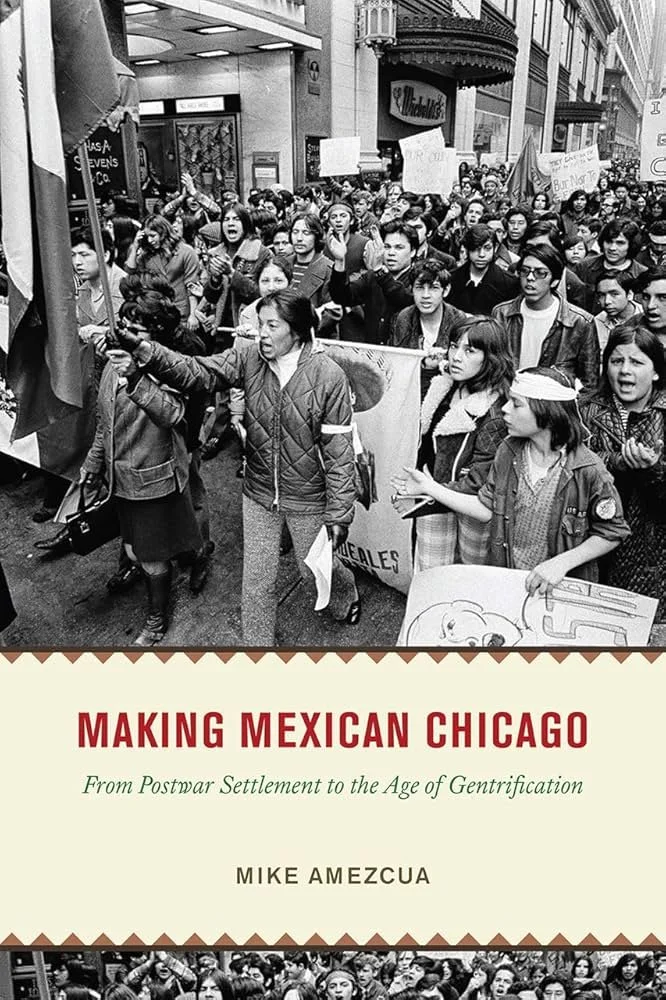
Our ongoing advocacy and community initiatives have been formally recognized in the concluding analysis of "Making Mexican Chicago: From Postwar Settlement to the Age of Gentrification"(University of Chicago Press).
Authored by Dr. Mike Amezcua, this seminal work has quickly become the definitive historical record of the Mexican American struggle for spatial justice, political autonomy, and economic survival in Chicago. To be featured in its conclusion is not merely a citation; it is an acknowledgement that our work represents the contemporary frontier of the historical forces Amezcua describes.
Situating Our Work in the Historiography of the City
Dr. Amezcua’s research meticulously tracks how Mexican immigrants and Mexican Americans navigated the "rust belt" transition, urban renewal, and the shifting boundaries of the city's bungalows and barrios. By concluding his narrative with our organization, Amezcua bridges the gap between the mid-century fight for housing and the twenty-first-century resistance of GPLXC.
In the conclusion of his book, Dr. Amezcua writes:
"The outcome is evident throughout the Mexican Bungalow Belt, including Gage Park, once the seedbed of racial bigotry. Today, Gage Park is home to thousands of Laitno immigrants and their mixed-status, multigenerational families. One of its new organizations, the Gage Park Latinx Council (GPLXC), has responded to the Covid-19 crisis by organizing fundraisers and creating a food pantry for families experiencing food and housing insecurity. Many of its community members work in high-exposure occupations as cooks, cleaners, and factory workers. Since the start of the pandemic, many have been laid off or furloughed. Amid the destruction wrought by the coronavirus, GPLXC has called into question the harmful paradox that simultaneously hails latino immigrant workers as “essential” and “saviors” in a society that also treats them as expendable. Latinos in Chicago have had infection rates triple that of whites and a disproportionate numbers of deaths. Along with its community organizing, GPLXC has also engaged, rather than ignored, Gage Park’s long history of racial exclusion with an aim to renew the politics of sanitary and social justice after a violent resurgence of anti-Latino nativism in America.”
The Socio-Political Significance
This scholarly recognition highlights several key pillars of our mission through an academic lens:
Spatial Justice: Our efforts to combat divestment caused by white flight are identified as a direct continuation of the mid-century "fight for space."
Institutional Memory: We serve as a continuation between the activists of the 1960s and 70s, leaning on our ancestors and building upon their work toward social justice.
Political Agency: Our model of community-led power is cited as a vital mechanism for ensuring that Mexican Chicago remains a site of cultural permanence.
A Testament to Collective Action
Academic history often focuses on the "great men" or "major events" of the past. However, Dr. Amezcua’s inclusion of our work reinforces a more nuanced historical truth: that the fate of the city is determined by the collective, persistent efforts of community members and grassroots organizations.
We are deeply grateful to Dr. Amezcua for his rigorous scholarship and for recognizing our role in the ongoing narrative of this city. We invite our supporters and partners to engage with this text to better understand the historical weight of the work we do every day.